Death Workers and the Problem of a Tight Voice
Nurses are so fascinating to me - not so much the brand-new nurses still fumbling the needle into my vein, but the nurses who can pop a PICC line like a magician with a worn-in deck of cards. Shuffle, flip, pick. Nurses who, with gloved hands, tear surgical tape into strips - rip, rip, rip - snap an alcohol swab, wipe, tap the vein, slide the needle, flash of blood, flush with saline, lock it down, label it done, toss the wrappers - all in one synchronized sleight of hand before I even have time to brace. They fascinate me.
I’ve had 15 fully anesthetized surgeries in my life, starting at 13. I’ve been hospitalized more times than I can count, and lately I’ve been back in it again, a string of tests, all okay so far. So I can say this clean: I’ve watched nurses do their thing for years. I’ve also walked with them in Nine Keys. I know the rhythm of their hands and hearts. I have a pretty good idea of what the role of the nurse is in the system, for better or worse, and I love them dearly.
When you zoom out on the hospital floor, you can see they move like synchronized swimmers - taking their positions, starting at one end of the hall, rolling computers around in quiet arcs and returns.
They have a role. They know their job. They have titles and positions. They have choreography. Our culture makes space for them. It trains them. They are called to nursing, they go to school, they get in line with their marching orders, they serve. Our culture knows what to expect of them.
Like nurses, death workers work bedside - carrying families, offering comfort -but our culture doesn’t quite know where to place us.
Death workers don’t have lines, we have lineages. We don’t have roles the culture expects, we have a call that’s hard to name, impossible to standardize. And I like it this way. I want us in the middle, undefined, outside the system and in the cracks in the sidewalk where something still grows.
But what I keep seeing are death workers called to serve, trying to do it without guardrails and wondering why it feels so unsteady – getting discouraged and not going after the calling.
From years of mentoring as a spiritual counselor and death work teacher, I see the same struggle for death workers over and over again. It is not a lack of skill or knowledge. Those things can be learned. Those things can be remembered. What I see them carrying is something else entirely: past hurt, and the limitations handed to them through ding dang enculturation.
Many death workers don’t actually believe they have a real “right” to be doing this work. On the surface, it can sound like a question of experience or training. But it goes deeper than that. A lot of death workers have spent years being told they are too sensitive, too shy, too strange, too moody, too much - too everything.
At the same time, they feel a very real pull toward death work and grief work. But they don’t quite know where they fit. And part of that is because we’ve been trained to understand ourselves through roles and positions. Titles. Credentials. Clear lanes.
So instead of discovering their own shape in the work, many start trying to squeeze themselves into something that already exists. They reach for titles. They lean on “certified” as a way to steady themselves.
And I get it. Because unlike the hospital floor, there isn’t a clearly defined choreography here.
A lot of this struggle shows up in their throat. You can hear it in how they communicate. The over-explaining. The apologizing. The nervous laughter. The discomfort with silence.
Because when you’ve been labeled too much, too sensitive, too weird - and then you step into work that asks you to define things as you go, not just follow a script, in a culture that doesn’t really want to hear about death and grief anyway - your voice tightens.
That tightening isn’t a lack of capacity. It’s a response to a world that hasn’t made space for this work to move with the same clarity, permission, and choreography as something like nursing. It’s a response to being weird and knowing it.
So the work, in part, becomes this: not just learning how to sit with death, but learning how to be inside of it. As I teach, death work is not just a response to a situation, it’s a force. It’s a force like birth work is, like creativity is, like nature is. It’s not compatible with plastic containers.
Death work, again, as I teach it, is a navigation in the dark, it’s a vespertine flower blossoming without light, it’s root systems moving underground, it’s tide and pull and decay and return. And it often asks us to take on many roles at once: cultural educator, grief worker, death educator, artist, war witness, threshold-walker.
And from here, something else begins to take shape. Not a system handed down, not a role we step neatly into - but a world we are building, slowly, together. One where this work has texture and soft patterns and loose threads on purpose. One where our voices don’t have to tighten to be taken seriously. One where the “too muchness” is exactly what it needed.
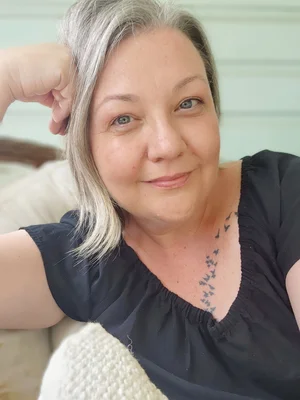
A part of my role in this work is to be present with those of you who feel the call to death work and help you find your voice inside of it. To tend to what’s been shamed. To make space for the way you already move, already feel, already create, already know.
This is how I see world-building – a world where people who are called to work outside of systems are seen as essential workers too. A world where your “weird” is actually the very thing needed. A world where death work, unbounded, educates wildly – seeding a culture that can finally sit with death without turning away, without shrinking it, without sanitizing it into something easier to look at. And where death workers and nurses are both essential, one inside the system, one at its edges, both doing the work that holds us together.